Real Transportation Strategies for Greenhouse Gas Emissions Reductions
4. Optimize the System: Improving the efficiency and operation of our roads
Improved operation of our highway system can help to improve mobility while reducing GHG emissions. A vehicle sitting in traffic consumes more energy and emits more GHGs per mile. The optimum speed for cars is about 45 miles per hour.
Greenhouse gas reductions may be achieved through maximizing the efficiency of the transportation system, through effective management of available road capacity and reducing delays. Intelligent transportation systems that cut down on congestion and idling in traffic include ramp metering, message signs warning of disruptions, real-time traveler information, variable speed limits to help cars flow smoothly onto a highway, and advanced traffic signal controls that change timing based on traffic load.
A vehicle sitting in traffic consumes more energy and emits more GHGs per mile than a vehicle operating at a moderate but consistent speed. Research conducted at the University of California at Riverside found that innovative traffic operations improvements such as reducing congestion, reducing excessive speeds and smoothing traffic flow can also have a significant impact on vehicle CO2 emissions in the near term.
Eliminating Bottlenecks
Elimination of traffic bottlenecks and relieving congestion can make significant improvements in emissions reductions.
One example is the Utah Department of Transportation’s $685 million Legacy Parkway Project—a 14-mile stretch of four-lane highway that provided an alternative route on the state’s most-congested freeway corridor—which has cut the average afternoon commute time from Salt Lake City to Farmington down from 42 minutes to just 16 minutes.
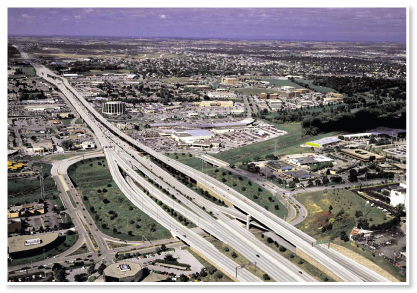
On July 28, 2006, the Governor of Nebraska cut the ribbon on an innovative $100 million project which will ease access to Interstate 680, and take 70 percent of the traffic off local roads. With daily traffic at Omaha’s busiest intersection expected to increase by 50 percent in the next two years, Nebraska’s Department of Roads came up with building two elevated expressway bridges, both 40 feet above grade and a mile long, and worked with contractors Hawkins Construction Company and HDR Engineering to deliver the project a year ahead of schedule. The West Dodge Expressway will relieve congestion at an intersection that sees more than 105,000 vehicles a day. The expressway bridges will carry three lanes of traffic in both directions, with local traffic using the existing at-grade West Dodge Road.
AASHTO’s Executive Director John Horsley said, “I like to point to this project as a demonstration that you can, in fact, ‘build your way out of congestion.’ By going up, rather than out they found a way to add capacity without having to acquire new right-of-way.”
For further information on improving operations see the AASHTO publication Optimizing the System: Saving Lives; Saving Time.
Ecodriving
Perhaps the most grassroots way for drivers to reduce their vehicle’s emissions is through ecodriving, which aims to instill new driver habits that reduce emissions. A recent pilot project called Driving Change, involving employees of EnCana Oil & Gas and Denver’s city government, was able to reduce carbon dioxide emissions by 10 percent—just by having drivers change how they operate their vehicles. Drivers were given feedback through a web site about their vehicle’s performance and were shown ways to improve it through slower braking, less idling, and fewer jackrabbit starts. By the end of the project’s test phase, carbon dioxide produced by 400 vehicles had dropped from 647 pounds a month to 545 pounds, a reduction of 40,800 pounds for all vehicles.
In some countries, like Sweden, ecodriving skills are mandatory in driver education. In the United States, companies like Pro Formance teach classes in ecodriving. According to the Auto Alliance, an organization representing vehicle makers, if everyone in the United States practiced Ecodriving, it would be equivalent to heating and powering nearly eight cities the size of Los Angeles.
 At their web site they offer the following tips:
- Avoid rapid stops and starts.
- Use cruise control.
- Plan your trips using the shortest distances.
- Avoid idling.
- Buy an automated road pass for toll roads.
- Use the highest gear possible.
- Check tire pressure monthly.
- Remove excess weight from your trunk.
Reducing greenhouse gases 80 percent by 2050 is a realistic goal, and we can reach it if we keep ourselves open to new ideas, technologies, and policies that offer the promise of lowering emissions.
Conclusion
Reducing greenhouse gases 80 percent by 2050 is a realistic goal, and we can reach it if we keep ourselves open to new ideas, technologies, and policies that offer the promise of lowering emissions.

State transportation departments have endorsed a wide range of transportation strategies to reduce greenhouse gas emissions. These include:
- public participation and transparency in the development of strategies to reduce greenhouse gas emissions,
- strong Federal research and development to develop cleaner vehicles and fuels;
- reducing the VMT growth rate to 1 percent annually
- a new Federal program of $100 million annually to coordinate and improve land use;
- increased transit funding from $10.5 billion to $18.5 billion each year;
- doubling of transit ridership;
- greater support for biking and walking $500 million or more each year;
- intensified funding for more efficient highway operations;
- significant increases in intercity passenger rail; and
- increased reliance on non-highway modes for freight transportation.
For further information on Real Transportation Solutions for Greenhouse Gas Emission Reductions, visit AASHTO’s website at: http://www.transportation1.org/RealSolutions/index.html
