Real Transportation Strategies for Greenhouse Gas Emissions Reductions
2. Better Cars: Increasing vehicle fuel efficiency
 More fuel efficiency means less fuel used. Makes sense. How much this saves, though, is amazing. The average fuel economy for today’s fleet is approximately 20 miles per gallon. A study by New York City-based infrastructure consultancy, engineering, and construction management firm Parsons Brinckerhoff found that if light-duty vehicles average 100 miles per gallon by 2050, and the growth of vehicle miles slows to one percent a year, then greenhouse gas emissions can be reduced by 60 percent.
If that 100 mpg number by 2050 seems high, consider that the government’s new CAFÉ (Corporate Average Fuel Economy) standards require that new cars must average 39 mpg and trucks must average 30 mpg by 2016, just seven years away.
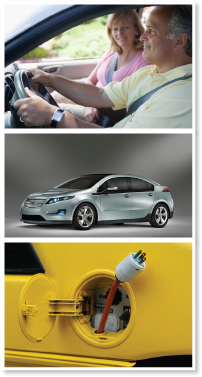
Already, automakers have announced cutting-edge, high-mileage cars for coming years. Honda’s 2010 Insight hybrid, which went on sale April, 22—Earth Day—promises more than 40 miles per gallon, and Toyota’s 2010 Prius hybrid offers a 50+ mpg combined fuel economy. On the zero emission side, Chevrolet’s 2011 model Volt electric car can travel up to 40 miles on one charge which makes it ideal for more than 75 percent of the country’s commuters. Moreover, it doesn’t require any special charging station; any standard electrical outlet will work. For those traveling longer distances, the Volt has a gasoline-powered, range-extending engine that drives a generator—that charges the batteries—for going beyond the 40-mile range. Likewise, Toyota announced plans this year for the FT-EV, a battery-powered, four-seat, compact car. It is a ‘concept car,’ but the company promises an ‘urban commuter’ electric car, which can go 50 miles between charges, in 2012. Even luxury cars are going green. Mercedes Benz recently showed its BlueZERO E-Cell plug-in electric which can go 125 miles on a single charge. The BlueZERO E-Cell Plus adds a small gas engine to charge batteries, extending its range to 370 miles, and the BlueZERO F‑Cell has a fuel cell that converts a tank of compressed hydrogen into electricity for 350 miles of nearly zero emissions.
Every drop counts, according to the Union of Concerned Scientists who say that for every gallon of gasoline consumed, approximately 24 pounds of greenhouse gases are released into the air. This not only includes burning gas in our vehicles, but also the five pounds of greenhouse gases released during drilling, refining, and distributing gasoline. Increasing fuel economy standards to 35 mpg by 2020, UCS says, can cut annual greenhouse gas emissions by 206 metric tons in 2020.
