Real Transportation Strategies for Greenhouse Gas Emissions Reductions
 3. Better Fuels: Shifting to fuels that produce low or zero carbon dioxide emissions
We are already well on our way in this area. Hybrid vehicles, that use a combination of gasoline and electricity and can get over 50 miles per gallon, are becoming common on our roads. Many states, like Virginia, for example, promote their use by allowing single drivers in hybrid vehicles to ride in HOV lanes along with carpoolers.
Hybrids typically achieve greater fuel economy and lower emissions than conventional gasoline engines. Some current hybrids, including the Honda Civic, Honda Insight and Toyota Prius, produce even less emissions than the level recommended by the U.S. Environmental Protection Agency.
A 2008 UK study The King Review of Low-Carbon Cars noted that, in the long term, carbon-free road transport fuel was the only way for Great Britain to ‘decarbonize,’ essentially achieving an 80 to 90 percent reduction in emissions. Interestingly, the report suggested that while biofuels offer great benefits in the early and medium stages of our move to zero emissions, too much reliance on biofuels could put a great strain on the earth’s natural resources.
While hybrids currently offer great paybacks, they are a bridge to the ultimate goal of zero-emission vehicles which would most likely run on electricity or natural gas. Hybrids use gasoline for power, but the engine also charges batteries for use when the engine is off. As we move toward totally electric cars, we’re seeing hybrid-hybrids or ‘plug-in hybrids’ that can receive electric charging from outside the vehicle itself.
In fact, for the first time, a plug-in hybrid was named the 2009 North American Production Preview Vehicle of the Year, an award reserved for vehicles based on an existing model that has been announced or planned for production. A panel of automotive journalists named the Karma Sunset over a list of seven other finalists from major automakers. The car is powered by two electric motors and a 2-liter turbocharged engine from General Motors. Automaker Fisker estimates that a fully charged car will go 50 miles before the gas engine has to take over.
Electric Vehicles
 In June 2001, REVA Electric Car Company Private Ltd. in India produced that country’s first electric vehicle, the REVAiCar, and more have been produced than any other currently selling electric car. The 3-door hatchback microcar can go about 50 miles on an eight-hour charge and is suited for low-speed urban transportation.
In 2008, California-based Tesla Motors began production of the Tesla Roadster which can travel 244 miles on a single charge of its lithium-ion battery pack. The car is fast and can reach 60 miles per hour in under four seconds. The company released a newer version of the roadster in January with adjustable dampers and a new motor that offers even faster acceleration. Although miles per gallon cannot be measured on electric cars, the Roadster’s equivalent gas consumptions would be about 105 mpg. Other full-sized electric cars are in production including the AC Propulsion eBox, a battery-powered version of the Toyota Scion xB, and the Blade Electron built in Australia.
Volkswagen recently announced that it will introduce its first electric car in 2013 and UK-based Liberty Electric Cars is re-engineering Range Rovers to run on electricity.
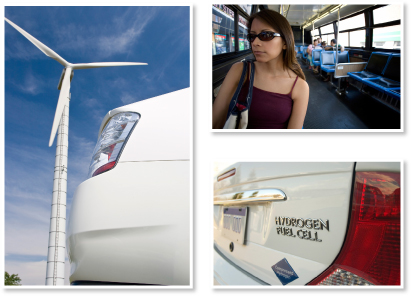
Cities around the world are already vying to become models for promoting electric vehicles. Tokyo has designated eight cities and prefectures across Japan as so-called EV towns. The strategy is to work with local governments to provide both residential and public charging options, while wooing public support with educational efforts and tax and other incentives for purchase of electric vehicles. With subsidies, the actual cost to purchase a Mitsubishi iMiev electric vehicle will be $36,000.
The port city of Yokohama, will install 100 public, rapid-electric chargers, and offer its own subsidy for 150 EV purchases. In the United States, San Francisco and Portland are already competing to become the first to offer electric charging stations.
Natural Gas Vehicles
Natural gas offers an excellent alternative to gasoline-powered cars because it has been used successfully throughout the world especially for buses in congested environments. More than 7 million natural gas-powered vehicles are on the world’s roads according to the International Association of Natural Gas Vehicles. The United States alone has about 130,000 natural gas buses. [http://www.iangv.org/tools-resources/statistics.html ]
The United States does not yet have an infrastructure to fuel natural gas vehicles on a large scale, but because many homes already use natural gas for heating and cooking, these could be used to fuel personal vehicles provided that a refueling system was connected to the gas line. One company, Fuel Systems Solutions, Inc., is working on a home natural gas refueling system called the Phill Home Refueling Appliance in partnership with Honda for its American GX model.
Natural gas must be stored in cylinders, usually located in the vehicle’s trunk. Although the most common form is Compressed Natural Gas (CNG), it also comes in the less common liquid form known as Liquefied Natural Gas (LNG).
One benefit of Natural Gas Vehicles (NGV) is that you can convert traditional gasoline engines to run on natural gas. Many car and light truck makers, including Ford, Toyota, and Volkswagen, have natural gas versions of their vehicles available for sale.
As far as the environment is concerned, natural gas has the highest energy/carbon ratio of any fossil fuel, meaning that it produces less carbon dioxide per unit of energy than any hydrocarbon.
Major reductions in greenhouse gas emissions will depend to a large extent on achieving technological breakthroughs that dramatically reduce emissions per mile. In addition to the billions being invested in research by private industry, the federal government is also increasing research such as the FreedomCar program examining hydrogen fuel-cell vehicles.
When looking at the bigger picture, you see the necessity of achieving not only national, but global greenhouse gas reduction goals. It is estimated that India, China, and Brazil will collectively outstrip United States’ vehicle ownership by 5 to 1 by 2050. From a world-wide perspective, it is evident that decarbonizing vehicles and fuels is an essential strategy.
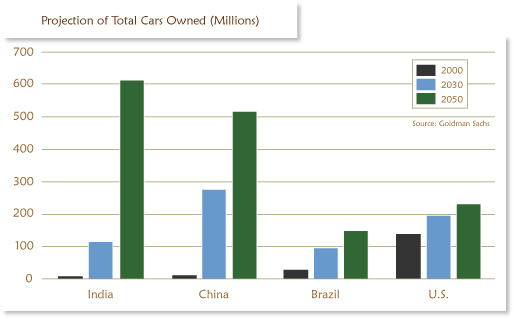
Source: Goldman Sachs

