|
Page Content
|
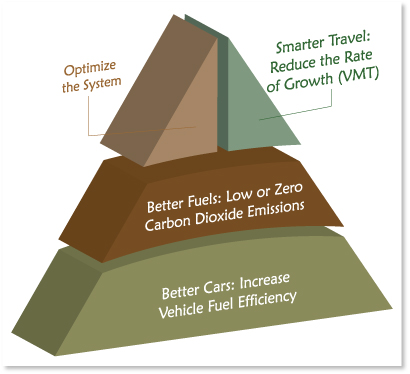
Autos and light-duty trucks contribute 16.5 percent of the greenhouse gases in the United States. States are looking at the best ways to reduce these emissions while sustaining the transportation services people and businesses depend upon. We are committed to doing our part to help achieve the goal of reducing U.S. greenhouse gas (GHG) emissions 80 percent by 2050. Our strategies include: |
|
|
|
|
How can we reduce greenhouse gases produced by cars and light trucks without sacrificing jobs and our way of life? There are many options on the table—driving less and more efficiently, using alternative fuels, building more fuel-efficient cars. In fact, there is no single best way to reduce emissions from these vehicles—which produce 16.5 percent of all greenhouse gases in the United States. The real answer is a combination of new technologies, cutting-edge public policy, and changing how we drive. |
|
The American Association of State Highway Transportation Officials and its state members are committed to a goal of reducing greenhouse gases 80 percent by 2050, compared to 2005 levels, through a combination of four basic strategies: |
- reducing the annual growth in driving,
- increasing vehicle fuel efficiency,
- shifting to fuels that produce low or zero carbon dioxide, and
- improving the efficiency and operation of our roads.
|
 |
 |
|
EPA Inventory of U.S. Greenhouse Gas Emissions and Sinks (Feb. 2008) | |
|
|
None of these are ‘blue-sky’ schemes; all are realistic, reasonable, and achievable ways to cut emissions. Although each idea alone contributes to reducing greenhouse gases, combined they offer an extremely effective and powerful plan. As federal, state, and local governments, industry, and the environmental community work to identify the combination of strategies that will enable us to meet GHG reduction goals, it is important to determine what we can realistically expect to achieve from the various solutions being advocated—some of the ideas above will be able to achieve much greater and more cost-effective reductions than others. Some states and companies have already begun testing or implementing these ideas. So have many foreign countries. |
|
|
|
|
